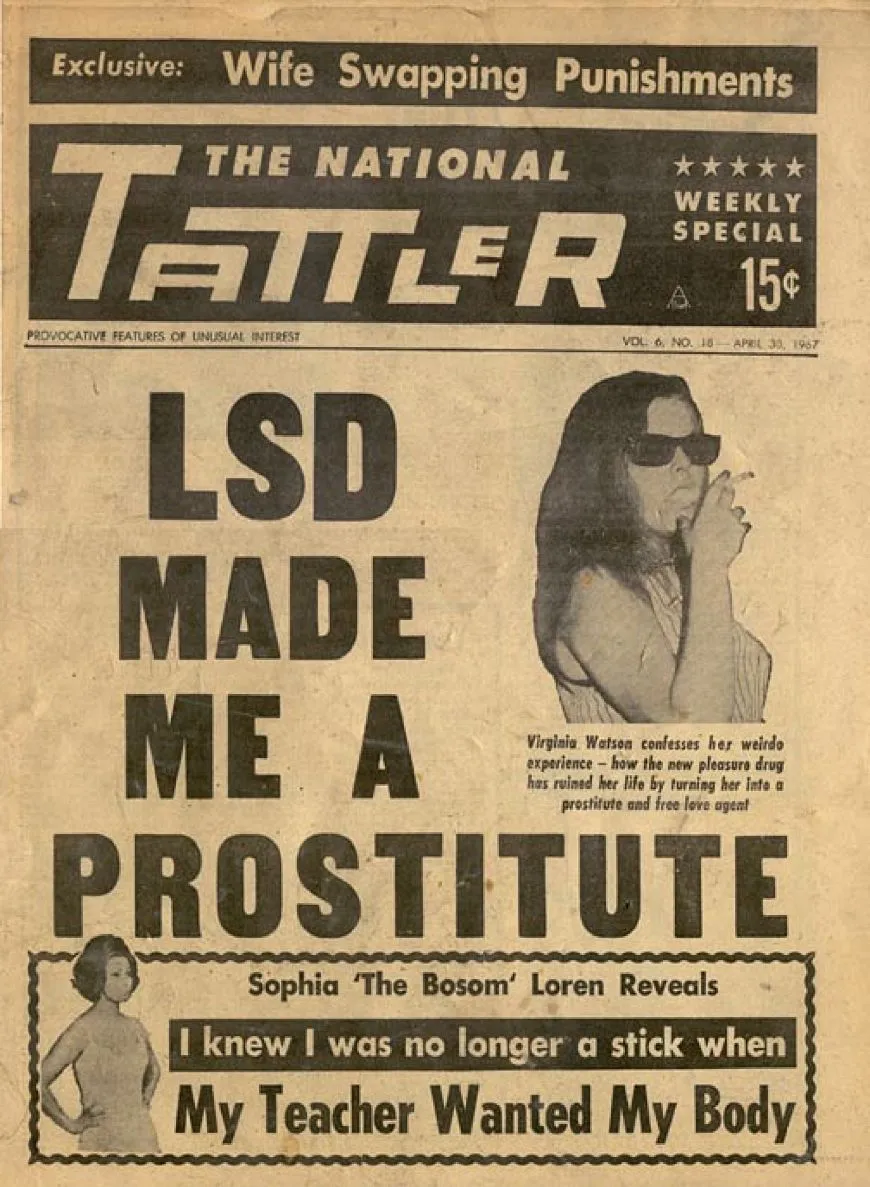
I really dislike the phrase “hard drug.” We live in the twenty-first century, science has come a long way, and we still talk about psychoactive substances as if we were looking for witches to burn. We agree that alcohol and cigarettes are harmful, yet you can buy them in any store. Cannabis is illegal, though not everywhere anymore. For many people, LSD still means a straight road to madness and a jump out of a window.
Lysergic acid diethylamide, LSD or simply acid, has very low physical toxicity and little potential for addiction. At the same time it can seriously mess with your head if you take it unprepared and with nobody looking after you. Its history reads like a spy film, and in 2026 it is coming back into medicine through phase 3 clinical trials.
When I first wrote about LSD in 2019, psychedelic therapy was a curiosity from documentaries. A lot has happened since, and some of what I wrote back then turned out to be wrong. I’ve corrected those parts below and added a section on what has changed.
How harmful is LSD compared with alcohol?
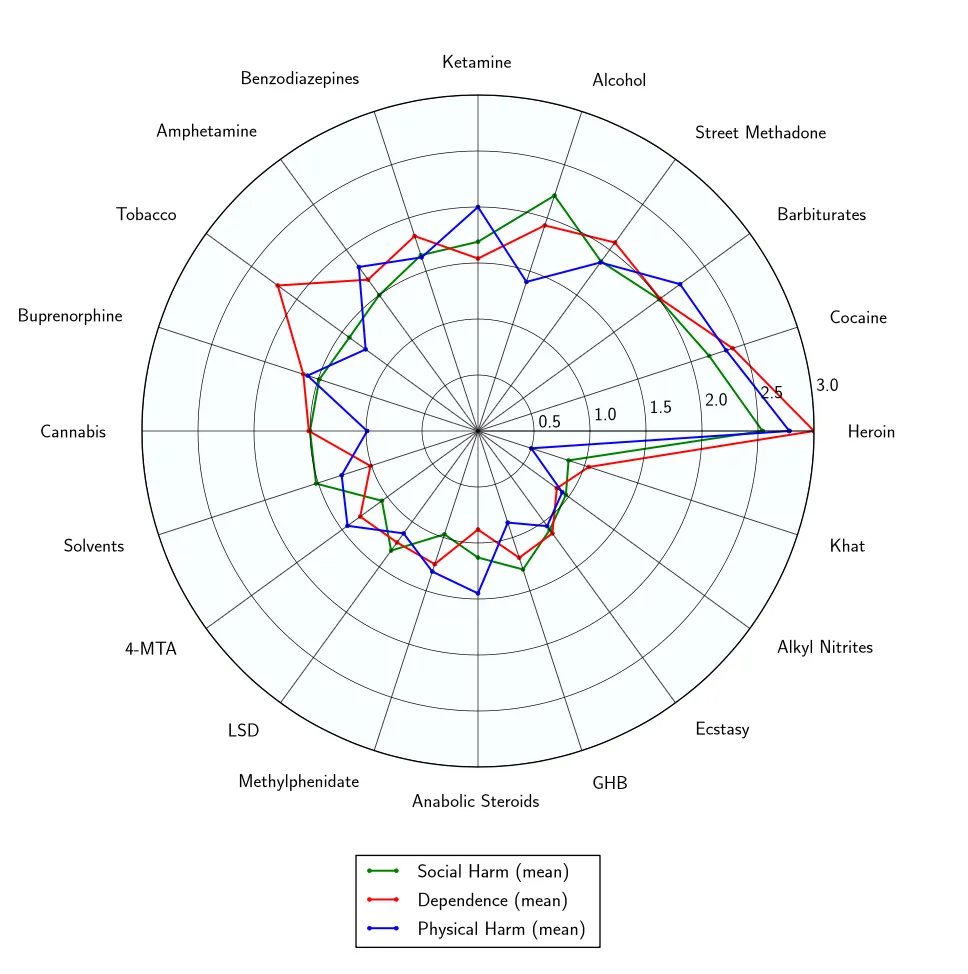
A good starting point is the ranking of drug harms that David Nutt, Leslie King, William Saulsbury and Colin Blakemore published in The Lancet in 2007. Experts rated 20 substances in three categories: physical harm, risk of dependence and social harm. The result suggests that something is wrong with our laws.
Three years later Nutt and colleagues repeated the exercise with a more careful method: 16 criteria, split into harm to the user and harm to others. According to Imperial College London, the results on a scale of 0 to 100 were:
| Substance | Overall harm (points) |
|---|---|
| Alcohol | 72 |
| Heroin | 55 |
| Crack cocaine | 54 |
| Tobacco | 26 |
| Cannabis | 20 |
| Ecstasy (MDMA) | 9 |
| LSD | 7 |
| Magic mushrooms | 5 |
In fairness, these are expert ratings rather than lab measurements, and they apply to the UK. Alcohol also comes top partly because almost everyone drinks it. Even so, the conclusion is hard to wave away: the law ranks substances by history and habit, not by how much harm they do. Europe has lived with alcohol and tobacco for centuries, while LSD showed up at the wrong time and in the wrong company. Crack, near the top of the table, is a story of its own, which I tell in my post on cocaine purity and narco-subs.
What is LSD and how does it work?
LSD is a semi-synthetic compound derived from substances found in ergot, a fungus that grows on cereal grains. It works in doses measured in micrograms, millionths of a gram. In the brain it binds mainly to the serotonin 5-HT2A receptors, which changes perception, thinking and the sense of self. The effects usually last 8 to 12 hours.
Physically, LSD is surprisingly non-toxic. Tolerance builds so quickly that taking it day after day is pointless, which is why it isn’t addictive the way alcohol or opioids are. That doesn’t make it safe, and I cover the real risks below.
A short history of LSD: from Sandoz to prohibition
LSD was first synthesized by the Swiss chemist Albert Hofmann on November 16, 1938, at the Sandoz laboratories in Basel. (In 1996 Sandoz merged with Ciba-Geigy to form Novartis.) Hofmann was looking for a drug to stimulate circulation and breathing. The compound didn’t live up to expectations and went on the shelf.
Hofmann came back to it in April 1943. On the 16th he accidentally absorbed a small amount and felt strange effects, and on the 19th he deliberately took 250 micrograms. He then rode home on his bicycle, which is why psychedelic enthusiasts celebrate April 19 as Bicycle Day. From 1947 Sandoz distributed LSD under the name Delysid as a tool for psychiatric research. Doctors hoped it would help them understand psychosis and speed up psychotherapy.
The CIA, MKUltra and experiments on soldiers
The intelligence services took an interest quickly. In 1953 CIA director Allen Dulles approved MKUltra, a program that studied LSD, among other things, as a “truth serum” and a tool for breaking people under interrogation. Some of the experiments were carried out on people who had no idea what they were being given. The symbol of this madness became Frank Olson, an army scientist whose drink was secretly spiked with LSD in November 1953. A little over a week later he died in a fall from a window of a New York hotel.
Most of the program’s records were destroyed in 1973 on the orders of CIA director Richard Helms. The public learned the details only in 1975, from congressional investigations and the Rockefeller Commission.
The military experimented too. The Americans tested LSD at Edgewood Arsenal, and in 1964 the British gave it to Royal Marines during an exercise. Armies have never been shy about drugs (the Wehrmacht marched on methamphetamine, as I describe in my post on Pervitin), but this one did not improve anybody’s fighting spirit. The film of the British test survives, and it’s worth watching to see what is left of military discipline on acid.
Tusko the elephant, the most famous victim of a bad dose
The most absurd chapter of this story took place on August 3, 1962, at the Oklahoma City zoo. The psychiatrists Louis Jolyon West and Chester Pierce and the zoo director Warren Thomas wanted to find out whether LSD would trigger musth in an elephant. Musth is a periodic surge of hormones during which bull elephants become extremely aggressive. Tusko the elephant was injected with 297 milligrams of LSD, thousands of times a typical human dose. Within minutes he collapsed and went into convulsions, and an hour and forty minutes later he was dead.
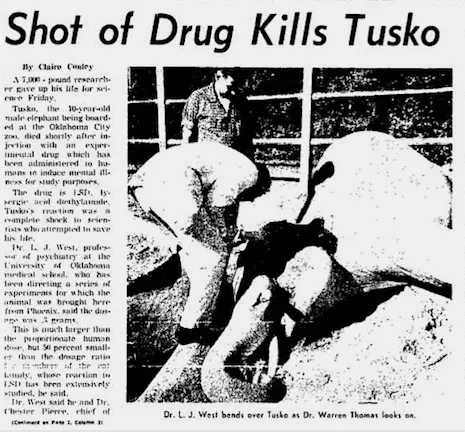
Nobody knows for sure what killed him. The doctors trying to save him also gave him an antipsychotic and a barbiturate. When the psychopharmacologist Ronald Siegel later gave comparable doses to two elephants in their drinking water, both survived, although they behaved abnormally for a few hours. The story says more about the arrogance of scientists than about LSD.
Hippies, Nixon and the ban
In the 1960s LSD left the laboratory and became the fuel of the counterculture. The Vietnam War was on, and young people on acid were remarkably unwilling to go and fight in it. The first US states banned LSD in 1966: Nevada in May, California in October. That didn’t stop a group of young men in Laguna Beach from registering a church built around it, as I describe in my post on the Brotherhood of Eternal Love. In 1970 the federal Controlled Substances Act put LSD in the strictest category, and in 1971 the UN Convention on Psychotropic Substances followed.
President Richard Nixon declared drug abuse “public enemy number one” in 1971, and in the 1980s Ronald Reagan carried the campaign on. Research mostly stopped or went underground. Hofmann called LSD his “problem child” in the title of a 1979 book, and he died in 2008 at the age of 102. The propaganda of that era was so effective that we still hear its echoes from parents, teachers and priests.
Do we owe the computer revolution to LSD?
It’s one of Silicon Valley’s favorite legends. There is something to it, though less than people like to claim.
- Steve Jobs told New York Times reporter John Markoff that taking LSD was one of the two or three most important things he had done in his life. In his book What the Dormouse Said, Markoff describes how the 1960s counterculture around San Francisco intertwined with the first computer enthusiasts.
- Kary Mullis, the Nobel laureate who invented PCR, said he seriously doubted he would have come up with PCR if he had never taken LSD.
- Michael Pollan, author of How to Change Your Mind (2018), argues that it is no accident that the computer revolution and the psychedelic revolution grew up in the same place at the same time.
In the first version of this post I also repeated anecdotes about Vint Cerf and the engineers at Xerox PARC. I couldn’t find a reliable source for them, so I’ve taken them out. A little critical thinking helps here. A handful of brilliant people who took LSD doesn’t prove that LSD makes people brilliant, because we never hear about the thousands for whom it did nothing or did harm.
LSD as medicine: what do we actually know?
In 2019 I wrote that the best-studied use of LSD was treating depression. That was inaccurate. In the 1950s and 1960s most controlled trials were about alcoholism. A 2012 meta-analysis by Krebs and Johansen covered six randomized trials with 536 participants: a single dose of LSD as part of treatment was associated with less alcohol misuse (odds ratio 1.96).
I also wrote that the rest of medicine was racing ahead while psychiatry stood still. That was an exaggeration, because good psychotherapy, cognitive behavioral therapy for example, really works. But I had a point. Many psychiatric drugs are taken for years, some patients respond to none of them, and for decades genuinely new mechanisms of action came along very rarely. No wonder psychiatry is looking at psychedelics again.
Microdosing: fad or method?
In Silicon Valley, microdosing is fashionable: regularly taking amounts too small to feel high, in the hope of a better mood and more creativity. Serge Faguet, an entrepreneur from that world, even described in an article how a very large dose of LSD supposedly accelerated his personal growth for good. But that is one person’s account.
A better source is a 2021 study by Balázs Szigeti and colleagues at Imperial College London. Participants blinded their own capsules, so they didn’t know when they were taking a microdose and when a placebo. Both groups improved, and they did not differ significantly. Most of the enthusiasm for microdosing can be explained by the placebo effect.
MDMA for PTSD: from an Israeli film to the FDA
In the spring of 2019 I watched Trip of Compassion, a documentary by Gil Karni. It follows patients with post-traumatic stress disorder (PTSD) who were treated with MDMA, known on the street as ecstasy, at the Be’er Ya’akov mental health center in Israel. The camera records entire sessions. The scene that stayed with me most is the one where the therapists tell a patient that the blanket in front of her stands for her abusers. The woman throws the blanket off the bed and starts to rejoice, as if after years she had regained control over something.
Back then I wrote that MDMA works like LSD, only for a shorter time, and I need to correct that simplification. MDMA isn’t a classic psychedelic but an empathogen. It releases serotonin, norepinephrine and dopamine in the brain, alters perception less, and above all strengthens the feeling of safety and closeness. That lets patients talk about the things they normally run away from. It also matters that it lasts a few hours rather than a whole day, because each session is run by two therapists, and every hour of their time costs money.
The center in the film was one of the sites of the phase 3 trial MAPP1, whose results were published in 2021. That trial and a second phase 3 trial (MAPP2, 2023) showed clearly greater improvement after therapy with MDMA than after the same therapy with a placebo. The rest of the story is less rosy, and I come to it below.
Bad trips and holotropic breathwork
I remember a priest in religious education class at school telling us about LSD and the “bad trip” that could end in death. Stanislav Grof, the Czech psychiatrist and one of the best-known researchers of LSD in psychotherapy, said the opposite. In his view a difficult experience can be the most valuable one, because it brings to the surface whatever needs to be faced. Grof turned 95 in 2026.
Both sides are partly right. In a clinic, with preparation, supervision and a proper conversation afterward, a hard session can be a breakthrough. At a party, in a strange place or alone, it is simply dangerous. A physical overdose of LSD is extremely rare, unlike with heroin, but accidents and dangerous behavior in a state of intense fear are not.
When LSD research was shut down in the early 1970s, Grof and his wife Christina developed holotropic breathwork. It combines fast, deep breathing, music and bodywork, and is meant to induce an altered state of consciousness without any substance. I once wrote that it was more dangerous than LSD. I have no hard data for that, so I withdraw it. What remains is a common-sense point: prolonged hyperventilation isn’t harmless for the body either.
Is LSD legal?
Almost nowhere. LSD is in Schedule I of the UN’s 1971 Convention on Psychotropic Substances, the treaty that national drug laws are built on, and the signatories treat it accordingly.
- United States. LSD is a Schedule I drug under the Controlled Substances Act, the category for substances with a high potential for abuse and no accepted medical use. A first federal conviction for simple possession carries up to a year in prison and a minimum fine of $1,000 (21 U.S.C. § 844). Most cases are prosecuted under state law, which varies from state to state.
- United Kingdom. LSD is a Class A drug under the Misuse of Drugs Act 1971. Possession carries up to seven years in prison, an unlimited fine or both, and supply or production up to life (GOV.UK). It is also in Schedule 1 of the Misuse of Drugs Regulations 2001, which means no recognized medical use, and research needs a Home Office license.
- European Union. There is no single EU drug law. LSD is illegal in every member state, but the penalties for possession vary: in some countries it is a criminal offense, in others an administrative one. Portugal is the best-known example of the second approach. Since 2001, possessing a small amount of any drug for personal use has been an administrative offense there rather than a crime, although the drugs are still confiscated (IDPC).
- Switzerland is the exception in Europe. Since 2014 its Federal Office of Public Health has issued permits for restricted medical use of LSD and MDMA, one patient at a time, mostly for people other treatments have failed (MLL).
Outside Switzerland and clinical trials, then, there is no legal LSD therapy, not even on prescription. The so-called legal LSD sold online as a research chemical, such as 1P-LSD, sits in a gray zone that keeps shrinking: in the UK it falls under the Psychoactive Substances Act 2016, Germany restricts it under its law on new psychoactive substances, and in the US it may be treated as an analog of LSD (Wikipedia).
Fakes sold as acid
A separate problem is that on the black market nobody guarantees what is on the blotter. Since 2010, substances from the NBOMe family, such as 25I-NBOMe, have been sold as LSD. They are active in tiny amounts, and according to the Wikipedia summary, poisonings have caused a racing heart, high blood pressure, seizures, dangerously high body temperature and kidney damage. By 2015 they had been linked to at least 19 deaths in the United States alone. For someone who thinks they are taking “safe acid,” this is one of the most serious risks.
What has changed since 2019?
In 2019 psychedelic therapy was a niche curiosity from documentaries and podcasts. Seven years later the picture is completely different.
- Australia went first. Since July 1, 2023, authorized psychiatrists there have been able to prescribe MDMA for PTSD and psilocybin for treatment-resistant depression.
- MDMA lost the first round in the US. In June 2024 an FDA advisory panel voted against it, and in August the agency rejected Lykos Therapeutics’ application and asked for another phase 3 trial. One of the objections was that participants could easily guess whether they had been given MDMA or a placebo. That same month the journal Psychopharmacology retracted three papers from earlier trials over ethical violations at one of the sites. The company laid off most of its staff and in 2025 renamed itself Resilient Pharmaceuticals. In August 2026 it resubmitted its application, this time without a new phase 3 trial. There is no decision yet.
- LSD is coming back as a medicine. MindMed, which has been called Definium Therapeutics since January 2026, received FDA breakthrough therapy designation for its LSD drug in generalized anxiety disorder in March 2024. In 2026 it announced positive results from three phase 3 trials: in June in depression (Emerge), in August in generalized anxiety (Voyage) and in September in a second anxiety trial (Panorama). According to Psychiatric Times, in Voyage, with 214 patients, the score on the Hamilton anxiety scale fell by 11.6 points 12 weeks after a single dose of LSD and by 6.2 points on placebo. In Panorama, with 245 patients, the gap over placebo was 5.1 points (Psychiatric Times). The company plans to file with the FDA in the first half of 2027. For now these are company announcements, not peer-reviewed papers.
- Psilocybin is even closer. Compass Pathways has two phase 3 trials in treatment-resistant depression behind it and has been sending its application to the FDA in parts. In April 2026 the agency also gave it a national priority voucher, which can cut the review to a month or two. In early November 2026 the company said the final part would be filed within two weeks (Compass, Q3 2026 results).
- The Czech Republic opened a door in the EU. Since January 1, 2026, Czech law has allowed psilocybin therapy in specialized healthcare facilities, aimed at severe cases that haven’t responded to other treatment. The country’s national mental health institute expected the first treatments in the second half of 2026 (NUDZ).
- Politics shifted too. On April 18, 2026, President Donald Trump signed an executive order telling his administration to speed up the review of psychedelic treatments, naming ibogaine in particular (AP via ADN).
- The law itself has barely moved. LSD, MDMA and psilocybin are still in the strictest category in the US, the UK and the UN conventions, and apart from a few exceptions psychedelic therapy is available only in trials.
My take
I wonder what psychiatry would look like today if research on LSD hadn’t been frozen for decades. Perhaps we would be treating some anxieties, traumas and addictions with a few well-run sessions instead of years of pills. Science is now making up for forty lost years, and the 2026 results suggest that the hippies didn’t make everything up.
I’ve learned a second lesson as well. Psychedelic enthusiasts can be just as uncritical as their opponents, as the MDMA saga at the FDA shows. The label “hard drug” still strikes me as meaningless, but the label “miracle cure” is just as wrong. In a doctor’s hands LSD may heal. In the hands of a random person at a party it can do real harm. And if what you are really after is a way to stress less, there are calmer methods that need neither a blotter nor a prescription.
Would you agree to psychedelic therapy if your doctor offered it?
Sources
- D. Nutt, L. King, W. Saulsbury, C. Blakemore, Development of a rational scale to assess the harm of drugs of potential misuse, The Lancet (2007); Imperial College London, news release on the 2010 multicriteria analysis.
- T. Krebs, P. Johansen, meta-analysis of LSD for alcoholism (2012); B. Szigeti et al., self-blinding microdose trial, eLife (2021); J. Mitchell et al., MAPP1, Nature Medicine (2021); lithium and psychedelics (2021).
- Law: 21 U.S.C. § 844; GOV.UK, drugs penalties; IDPC, drug decriminalisation in Portugal; MLL, psychedelics in Switzerland.
- 2026 developments: Psychiatric Times on Voyage and Panorama; HCPLive, MDMA application resubmitted; Compass Pathways Q3 2026 results; NUDZ, psilocybin treatment in Czechia; AP, executive order on psychedelics.
- Listening and watching: Tim Ferriss with Michael Pollan and with Stanislav Grof; Trip of Compassion.
Questions people ask
Who invented LSD?
LSD was first synthesized by the Swiss chemist Albert Hofmann on November 16, 1938, at the Sandoz laboratories in Basel. He discovered its psychoactive effects by accident in April 1943.
Is LSD legal?
Almost nowhere. LSD is in Schedule I of the UN’s 1971 Convention, a Schedule I drug in the US and a Class A drug in the UK, where possession carries up to seven years in prison. Switzerland allows limited LSD-assisted therapy with a special permit for individual patients.
Is LSD addictive?
LSD does not cause physical dependence, and tolerance builds so fast that taking it every day makes no sense. The main risks are psychological: intense fear, dangerous behavior while under the influence and psychosis in people who are predisposed to it.
What happened to Tusko the elephant?
On August 3, 1962, researchers at the Oklahoma City zoo injected Tusko with 297 milligrams of LSD to see whether it would trigger musth. He collapsed within minutes and died an hour and forty minutes later, after doctors had also given him other drugs.