Nobody was complaining that English was short of acronyms. Even so, in 2021 we got another one, and for a while it was everywhere. Collins Dictionary even made it its word of the year. When someone dropped it into a conversation, half the table exchanged the look of the confused grandpa from the memes. It didn’t come easily to me either, and I am a certified nerd.
The word is NFT. An NFT (non-fungible token) is an entry on a blockchain that works like a digital certificate of ownership for one specific thing, most often a picture file. Unlike bitcoin, every such token is different and can’t be swapped one for one for another.
That sounds simple until you hit the wall of difficult words. NFTs run on a blockchain, a blockchain relies on cryptography, and all of it runs on computers. I wonder who should try harder: technologists, to explain things more simply, or people who don’t get along with computers, to put in a bit of effort. Both, in my view, so I’ll explain NFTs as simply as I can.
I first wrote about NFTs in May 2021, at the height of the fever, and I was clearly more optimistic then than I am now. I have kept the explanations, fixed a few inaccuracies and added what happened to the NFT market in the following years, plus how not to fall for “NFT investments.”
What do you need to know before NFTs make sense?
Remember how everyone talked about flattening the curve during the pandemic? To really understand it, you had to understand exponential growth, and for that a bit of math helped.
NFTs are similar, only the chain is shorter: first blockchain, then cryptocurrencies, and finally tokens. Along the way you get an explanation of how bitcoin works, which is a decent bonus in itself. Anyone who would rather spend this time browsing a clothing sale has every right to.
How does blockchain work? A gradebook nobody can forge
A blockchain is a way of recording data that makes sure information, once written, can’t be quietly changed. Cryptography here isn’t about hiding data from prying eyes. It ensures that every new block contains a fingerprint (a hash) of the previous one, so all the blocks are linked together.
Picture a school gradebook. Grades are entered one after another, with one catch: the F you got in chemistry last week “knows” about the lucky B-minus you scraped a month earlier. If you wanted to quietly turn that B-minus into an A, you would have to rewrite every entry that came after it too. And because thousands of people keep a copy of the gradebook, everyone would see at once that your version doesn’t match theirs.
The technology has plenty of nuances, of course, but the principle is simple and allows for many uses. The most famous of them is cryptocurrency.
Bitcoin: one shared ledger of every transaction
Bitcoin is, at heart, a computer program with a set of rules and a database, and that database is the blockchain. This single, shared, public database stores a record of every transaction ever made in the currency, and anyone can download it. At the start of 2021 it was about 320 GB. By November 2026 it was past 780 GB (Blockchain.com).
Because it is a blockchain, it is easy to check whether the database is consistent, meaning nobody has changed a past entry to give themselves, say, a few more coins. The participants in the network look after that consistency together, and the so-called miners are paid for their work in new bitcoins. That is a decentralized system. With dollars or euros, banks know about the transactions, don’t publish them and keep order themselves. That is a centralized system.
How is an NFT different from bitcoin?
Back to school. In the world of cryptocurrencies, grades are a currency you can trade with classmates, and the history of every trade goes into a gradebook everyone can read. Your F in chemistry is worth exactly as much as your classmate’s F, just as 1 BTC equals any other 1 BTC. That is what “fungible” means: interchangeable.
An NFT works the other way round. Each token is one of a kind, has its own number and describes a specific thing. It is as if your F were signed by a particular teacher, dated, and given for one particular test. You can’t swap a grade like that one for one for any other.
There is one more difference. Bitcoin has to be bought or mined, but anyone can mint an NFT on a blockchain of their choice, paying only the network fee. That raises an obvious question: why would anyone want a token that anybody can create for anything?
What use is a one-of-a-kind F in chemistry?
On its own, none. But it shows how versatile a blockchain can be. In my view the most sensible use of NFTs is recording the history of artworks.
You can’t attach a token to a painting. You could tape a USB stick to the canvas, but it would peel off easily. An NFT earns its keep at the point of sale: it records who bought the work, who they sold it to and when, and that history can’t be changed afterwards. In the art world this history is called provenance, and it is sometimes worth more than the canvas.
The Knoedler scandal in New York shows why. Between 1994 and 2011 this venerable gallery sold almost 40 fake paintings presented as works by Rothko, Pollock, Motherwell and others, for about $80 million in total. They were painted in a garage in Queens by a Chinese-born painter, Pei-Shen Qian, and the dealer Glafira Rosales supplied them to the gallery along with plausible-sounding histories. The gallery closed in November 2011 (Wikipedia).
In 2021 I wrote that NFTs would put fraudsters like these out of business. Today I can see the weak spot in that argument. A blockchain guarantees that nobody can change an entry, but not that the entry was true. If a forger minted an NFT for a freshly painted “Rothko,” the blockchain would hold a tamper-proof history of a fake. Computer scientists call this the oracle problem: the chain is exactly as reliable as whoever feeds it data from the real world.
NFTs in practice: cats, cards and the first tweet
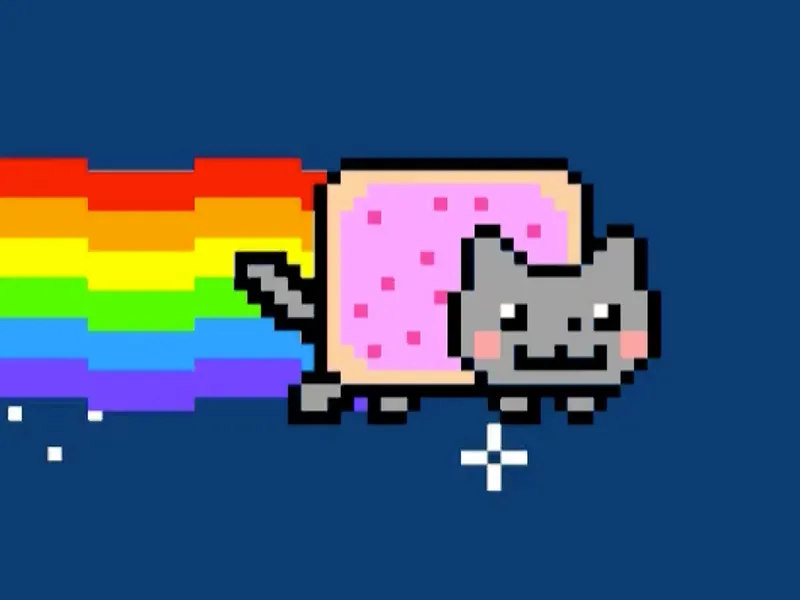
In practice NFTs are minted mostly for digital art, and often for pictures of cats and other essentials of life. The cat at the top of this post is Nyan Cat, a meme from 2011. Its creator, Christopher Torres, sold an updated version as an NFT in February 2021 for 300 ETH, about $587,000 at the time (Wikipedia).
There were much bigger sales too:
| What was sold | When | For how much |
|---|---|---|
| Everydays: the First 5000 Days, a collage by Beeple (Christie’s) | March 2021 | $69.3 million |
| Tim Berners-Lee’s source code for the World Wide Web (Sotheby’s) | June 2021 | $5.4 million |
| Jack Dorsey’s first tweet | March 2021 | $2.9 million |
| Christopher Torres’s Nyan Cat | February 2021 | 300 ETH (about $587,000) |
Sources: Wikipedia, Non-fungible token; Al Jazeera.
A small correction to what I wrote in 2021: Tim Berners-Lee invented the World Wide Web in 1989, not the internet, which already existed. The sale of his NFT, only announced at the time, took place at the end of June 2021.
The great hope of mediocre artists
Many artists saw NFTs as a chance to make money. The trouble was that they often had no idea what exactly they wanted to sell, or to whom. I found a good example on Twitter at the time.
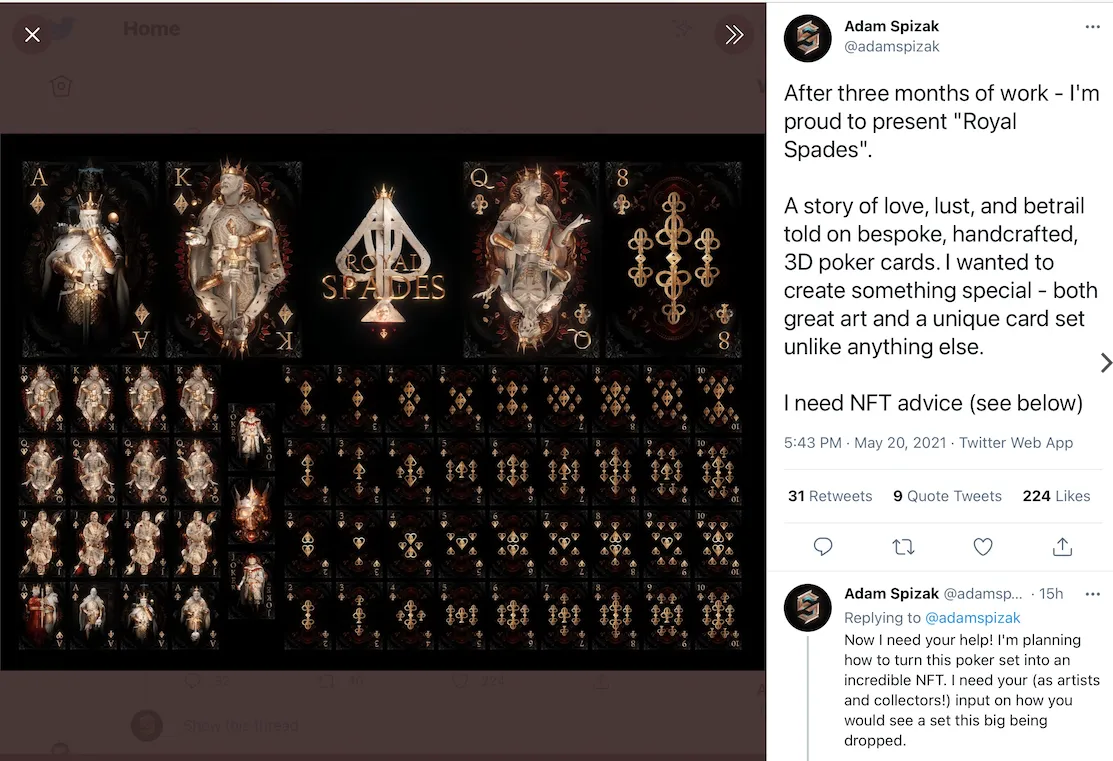
I won’t judge the cards themselves; they look impressive. What is telling is something else: after three months of work, the author asks the internet how to turn them into an NFT at all. My impression is that the fashionable format came first and the idea of what to do with it came second.
For many creators the arithmetic was brutal anyway. According to a market analysis from March 2021, cited on Wikipedia, most NFT artworks sold for less than $200, and a third for less than $100. For those under $100, fees came to between 72.5% and 157.5% of the sale price. The average small artist was more likely to pay into the business than to earn from it.
What exactly do you buy when you buy an NFT?
This is where a lot of misunderstandings start. When you buy an NFT, you usually don’t buy the picture or the copyright to it. You buy an entry on a blockchain confirming that the token belongs to you, and the token itself most often contains nothing more than a web address of the file. If the server with the file disappears, you are left with a certificate of ownership for something that no longer exists.
Some people also minted NFTs from other artists’ work without permission, and platforms were slow to respond to complaints. DeviantArt even built an algorithm that compares its users’ art with listings on NFT marketplaces.
What happened to NFTs after 2021?
In May 2021 I ended my original piece by saying that NFTs, like cryptocurrencies, had already proven their usefulness. The market soon tested my optimism:
- The boom. NFT trading reached about $17 billion in 2021, up from $82 million the year before.
- The crash. By May 2022 daily sales were 92% below their September 2021 level, and the number of active wallets had fallen 88%.
- The graveyard. According to a dappGambl report from September 2023, 95% of NFTs had fallen to zero value.
- A tweet for pocket change. Dorsey’s first tweet, bought for $2.9 million, was put up for sale in 2022 at $48 million. The top bid was $280.
Source: Wikipedia.
The fate of OpenSea, the biggest NFT marketplace, tells the story well. In January 2022 investors valued it at $13.3 billion. In August 2024 it received a notice from the US Securities and Exchange Commission alleging that tokens on the platform were unregistered securities, but in February 2025 the SEC closed the investigation. From July 2025 OpenSea let users trade cryptocurrencies directly. In the first two weeks of October 2025 it processed $1.6 billion in crypto trades and only $230 million in NFT transactions (Wikipedia).
NFTs didn’t vanish, they got cheap. In the second quarter of 2025 DappRadar counted $823 million in NFT trading volume, 45% less than in the previous quarter, even though the number of sales rose 78% to 12.5 million. More tokens changed hands for less money each.
One thing did change for the better. In 2021 critics rightly attacked NFTs for their enormous electricity use. In September 2022 Ethereum, which hosts a large part of the NFT market, switched to a mechanism called proof of stake, and according to ethereum.org its energy consumption fell by about 99.95%.
How to avoid being scammed by “NFT investments”
When something is fashionable and few people understand how it works, con artists show up fast. Ads for platforms and “investment bots” promising easy money from NFTs and cryptocurrencies still circulate online. If you are looking for reviews of one of them, do a few simple things before you send any money:
- Check the regulators’ warning lists. In the UK, the Financial Conduct Authority keeps a Warning List of firms operating without permission. Since March 2025, IOSCO, the global association of securities regulators, has run I-SCAN, which collects alerts from regulators around the world in one place. A firm missing from a list isn’t automatically legitimate, because scammers change names often.
- Run from guaranteed returns. As the US Federal Trade Commission puts it, “Only scammers will guarantee profits or big returns.” Nobody honest guarantees a profit in a market where 95% of NFTs lost their value.
- Don’t install remote desktop software at the request of an “investment adviser,” and never give anyone your online banking details.
To be clear, this is not investment advice.
My take, five years on
In 2021 I wrote that the future could be much better thanks to these technologies, as long as people tried to understand them instead of burning them at the stake. I would tone down the first part today. The second still holds, only it cuts the other way. My impression is that the people who lost most were the ones who bought NFTs without understanding anything.
The technology itself hasn’t gone away. A blockchain is still good for recording a history nobody should be able to change quietly, and an NFT can make sense as a certificate, a ticket or a proof of ownership. But it did not turn out to be the clumsy artist’s big chance. It was more like a lottery that a few people won while everyone else paid the commission. As with the 996 working hour system, most of the money went to whoever owned the platform, not to the people doing the work. So before the next fashionable technology arrives, I recommend a dose of critical thinking.
Questions people ask
What happened to NFTs?
After a boom in 2021, when trading reached about $17 billion, the market crashed in 2022. A 2023 report by dappGambl claimed 95% of NFTs had fallen to zero value, and in 2025 OpenSea, the biggest NFT marketplace, moved into cryptocurrency trading.
What is an NFT in simple terms?
An NFT is a unique token recorded on a blockchain that works like a digital certificate of ownership for one specific thing, usually a picture file. Unlike bitcoin, no token equals any other, so they can’t be swapped one for one.
Do you own the artwork or the copyright when you buy an NFT?
Usually not. The NFT proves you own an entry on the blockchain, and your rights to the work itself depend on the seller’s license. The file often sits on an ordinary server that the token merely points to.
Are NFTs worth anything now?
Some still find buyers, but the market is a fraction of its peak: DappRadar counted $823 million in NFT trading in the second quarter of 2025, against about $17 billion in all of 2021. It is a highly speculative market, and this is not investment advice.